Challenging Unreasonable and Unfair Decisions
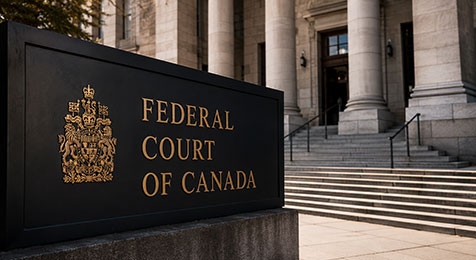
Almost every immigration and refugee decision in Canada — by IRCC, a visa officer abroad, the Refugee Protection Division, the Refugee Appeal Division, or the Immigration Appeal Division — can be challenged by way of judicial review in the Federal Court of Canada. Judicial review is not an appeal on the merits; it is a review of the legality of the decision — whether it was reasonable and whether it was made fairly.
The deadlines are very short. Under the Immigration and Refugee Protection Act, an application for leave and judicial review must generally be filed within 15 days of being notified of a decision made inside Canada, and 60 days for a decision made outside Canada. Missing the deadline can forfeit your right to challenge the decision. Contact us immediately.
The Two-Stage Process
Judicial review of an immigration decision proceeds in two stages:
Leave (Permission)
You must first obtain the Court's permission — "leave" — to proceed. After filing the application, the record and written arguments are submitted, and a judge decides on the paper record whether the case raises a fairly arguable issue.
The Hearing
If leave is granted, the Court schedules an oral hearing where counsel argue whether the decision should be set aside. If the application succeeds, the matter is usually sent back to a different decision-maker for redetermination.
The Standard of Review
In most immigration cases, the Court reviews the decision for reasonableness — asking whether it is justified, transparent, and intelligible in light of the facts and the law, following the framework set by the Supreme Court of Canada. Questions of procedural fairness — whether you had a fair opportunity to be heard — are assessed separately. We frame your case to the correct standard and identify the reviewable errors.
Decisions We Challenge
- Refused visa, work-permit, and study-permit applications.
- Refused permanent-residence and sponsorship applications.
- Negative refugee determinations and Refugee Appeal Division decisions.
- Negative humanitarian and compassionate (H&C) decisions.
- Negative Pre-Removal Risk Assessments (PRRA).
- Inadmissibility and misrepresentation findings.
What a Successful Application Achieves
Judicial review does not allow the Court to substitute its own decision and grant your application. Instead, where the application succeeds, the Court typically quashes the flawed decision and sends the matter back for a fresh decision by a different officer or panel — giving you another, properly conducted, chance.
Only lawyers and self-represented litigants may appear before the Federal Court — immigration consultants cannot. Given the short deadlines and the technical nature of these applications, it is important to retain experienced counsel promptly.